
Much of the conversation around AI in audio centers on its helpfulness in various publishing scenarios that include streaming, radio, and podcasting — the three content tentpoles covered in RAIN News. New studies flip that, focusing on how radio and podcast advertising can help AI brands gain marketing advantage.
The research is from audio advertising agency Oxford Road. (The 14-slide deck is freely available HERE.)
The top key finding lies between a suggestion and a mandate: “AI brands need to market themselves.” Hence this study. Beyond that lie seven other cardinal commandments. That interesting list of recommendations puts audio marketing squarely in the middle:
- There is a huge opportunity to market AI applications for the workplace: Most Americans use AI primarily for personal use. The emotional benefits and use cases of AI services for the workplace need to be articulated.
- Audio should be a centerpiece of AI media plans: Heavy podcast and AM/FM radio listeners significantly over-index on AI usage, awareness, and interest.
- AI ad creative must be sensitive to consumer apprehensions: Average Americans are guarded about AI. Creative strategy should be mindful of these anxieties. While brands and media agencies are very positive and excited about AI, average Americans are much more concerned.
- AI creative should be designed with four distinct generational targets in mind: The research reveals AI brands should adapt marketing to four different audiences (Gen Z, Millennials, Gen X, and Boomers).
- Ad creative should depict AI “as the tool in your hand, not the mind in control”: Build trust and belief in AI by positioning it as a collaborator, not a replacement.
- AI ad creative must prioritize emotion and creating positive memories over rational features and benefits: Focusing solely on speed, cost savings, and ROI misses the emotional impact on consumers. Emotional impact is what directly influences brand trust and purchase motivation. Beware “the cost of dull.” Boring ads require twice as much media investment to generate the same effect as interesting and emotion-based ads.
- Pre-test creative and messaging: Brands must rigorously pre-test the creative effectiveness of both AI-generated and traditional content before launch to understand their specific audience’s tolerance and sentiment toward AI.
All this is a prelude to the survey, which was conducted by consumer intelligence platform Quantilope. Two-thousand participants were surveyed last November.
In the study we absorb with interest some basic results about consumer use of AI. Examples:
Half of Americans use AI weekly. Most of that is personal use.
While brands and media agencies are “euphoric” about AI, consumers are “much more guarded. More than half of U.S. employees use AI.
A third of businesses use AI daily, for many purposes that depend on business size. Across firms of all sizes, the “main concern” is that AI will eliminate jobs. The main positive aspect is that AI saves time.
Audio listeners are the most interested in using AI. Type of listening? The top two formats for this result are Sirius XM , AM/FM radio via streaming. Further, heavy audio listeners use AI more often than light audio listeners.
Interestingly, podcast audiences are especially receptive to AI, broken out by an array of specific AI tasks. This very interesting result is charted below.
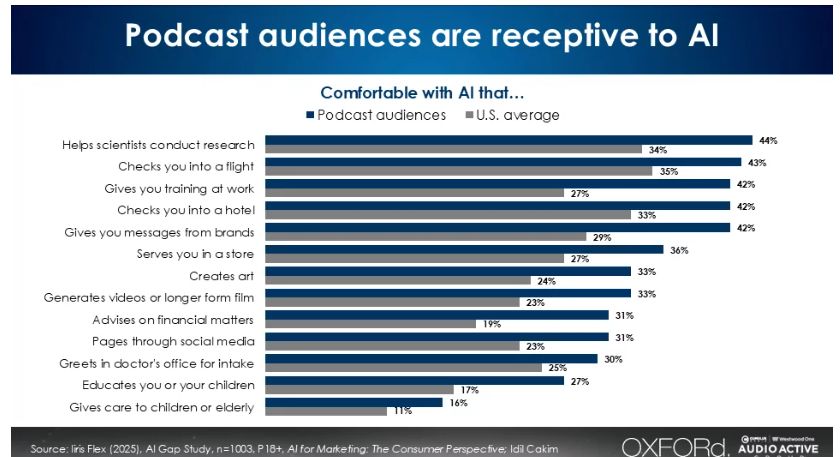
There’s much more to this piece of work, including an “AI brand scorecard that ranks listener responses about produce trust, ad recall, and other considerations across 14 AI apps.
- AI brands need to market themselves: Americans are vaguely aware and modestly interested in AI services. Weekly AI use (50%) is at the same levels of Internet use in 2001.
- There is a huge opportunity to market AI applications for the workplace: Most Americans use AI primarily for personal use. The emotional benefits and use cases of AI services for the workplace need to be articulated.
- Audio should be a centerpiece of AI media plans: Heavy podcast and AM/FM radio listeners significantly over-index on AI usage, awareness, and interest.
- AI ad creative must be sensitive to consumer apprehensions: Average Americans are guarded about AI. Creative strategy should be mindful of these anxieties. While brands and media agencies are very positive and excited about AI, average Americans are much more concerned.
- AI creative should be designed with four distinct generational targets in mind: Idil Cakim’s research reveals AI brands should adapt marketing to four different audiences (Gen Z, Millennials, Gen X, and Boomers).
- Ad creative should depict AI “as the tool in your hand, not the mind in control”: Build trust and belief in AI by positioning it as a collaborator, not a replacement.
- AI ad creative must prioritize emotion and creating positive memories over rational features and benefits: Focusing solely on speed, cost savings, and ROI misses the emotional impact on consumers. Emotional impact is what directly influences brand trust and purchase motivation.
- Beware “the cost of dull.” Boring ads require twice as much media investment to generate the same effect as interesting and emotion-based ads.
- Pre-test creative and messaging: Brands must rigorously pre-test the creative effectiveness of both AI-generated and traditional content before launch to understand their specific audience’s tolerance and sentiment toward AI.