
In an interesting piece of research from Sounds Profitable (HERE) it is revealed that U.S. podcast consumers are of two minds when it comes to AI acceptance. Consumers embrace AI as a tool for discovering shows or producing shows. But they reject the AI voicing of podcasts.
The Divide
The divide is easy to understand, inasmuch as AI voicing is naturally disagreeable for its automated sound in a highly personalized audio medium. People don’t just tune into a podcast, they tune into a podcaster.
That’s a quick and meaningful distillation of a 27-page report. An even more concise representation of this key learning:
“Tool yes, talent no” is how it’s expressed in the study deck. That presentation reports that only 22% of survey respondents accept AI-generated hosts, while 51% call them unacceptable.
An interesting related metric reports that 55% of Americans have seen or heard AI-made content. When the survey narrows down to podcast consumption, it finds that 20% of respondents had consumed AI content in podcasts.
The survey drills into consumer feelings about AI content, whether it was expected or unexpected. Interestingly, eighteen percent felt “tricked” when encountering unexpected AI audio.)
One might ask how audio AI is recognized by listeners, and in fact the survey did ask that. The majority response was “Looks or sounds artificial.” Nearly half of respondents knew AI audio because it was labeled as such. (Puzzlingly, 23% said “It’s uncanny.”
But the criticism of AI is not a stampede. Very interestingly, when asked “How acceptable do you find each use of AI in media production?” the most unacceptable result is only 51% AI-generated hosts or talent. So while AI narration is generally slammed in this report, pulling the cover off shows only middling unhappiness in the listeners market:
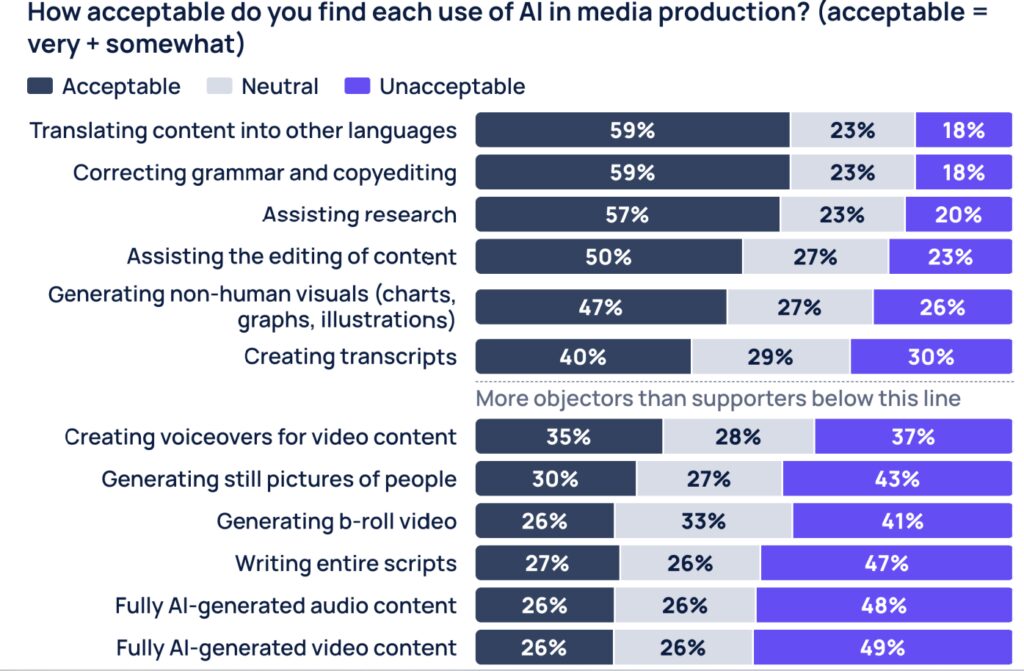
AI is not condemned as a production tool across the board in all creative stages. Audiences view artificial intelligence favorably when it supports human creators behind the scenes — not replacing voices or creative direction. The chart below reveals a spectrum of approval to disapproval:
Translation & Copyediting 59% Highest approval; valued for accessibility and polish.
Research 57% Widely accepted as a background prep tool.
Editing Content 50% Half of consumers support AI-assisted post-production.
Writing Entire Scripts 27% Steep drop-off when AI takes over creative authorship.
Full AI Audio/Video Production 26% Strong resistance to completely synthetic media.
AI-Generated Hosts / Talent 22% (51% reject) Major friction point; slightly higher among monthly listeners (29%).
The discovery function
There is creation, and there is consumption — the flip side of creation. AI plays a growing role there, too.
We learn that 30% of podcast consumers have used AI to discover shows. Of those who have tried this method, 60% found at least one show they stuck with. What are consumers specifically asking for:? The research has those answers:
- 44% ask for recommendations on a specific topic
- 37% look for shows similar to favorites
- 30% ask if a podcast is worth their time (We find this one particularly interesting)
- 29% search for a specific episode or segment
- 27% request a summary before listening.
AI discovery is good for creators
We find this part greatle interesting. The study determined that weekly listeners in the AI-discovery group consumer more average listening hours than other listeners. The numbers are:
- 6.7 hours per week (AI discovery)
- 5.5 hours per week (non-AI discovery)
Furthermore, these consumers are twice as likely to pay for ad-free listening, than other consumers.
As always we recommend the source, which is HERE.