
Research studies abound, measuring who listens to podcasts and how they listen. Much of that output is organized and presented by eminent audio researcher and Sounds Profitable partner Tom Webster. Such it is with the recently released presentation The Last Quarter: Understanding America’s Podcast Holdouts. The information in this package derives from a 2025 survey (“The Podcast Landscape 2025”) of over five thousand respondents.
It’s an interesting premise and a good idea. In the midst of podcasting’s steady growth as an industry and swelling audience, this study shines a respectful light on Americans who don’t listen, seeking to understand their demographics, their media choices, excavating the barriers to exposure, the social influences of the unlistening group, resistance to certain podcast characteristics, and the political profile of holdouts.
Basic demographics
In the first data slide of a 30-page deck, we learn that 25% of American adults have never listened
to a podcast. The demographics of that cohort skew toward older age (51+) and female (58%). The holdout group is overwhelmingly white (82%). and skewing to Spanish-speaking.
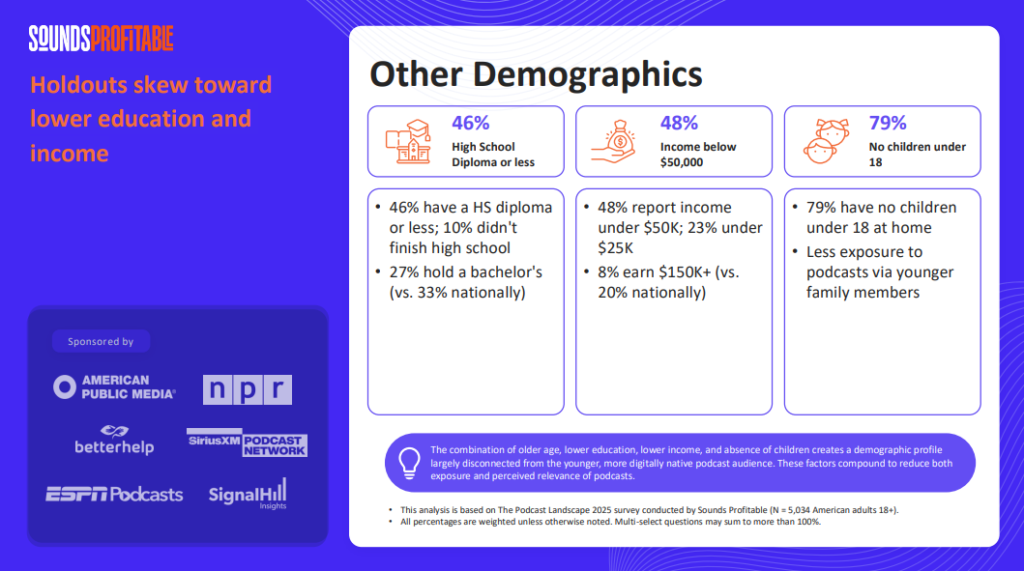
Three other measurements sketch the no-listen group along lines of lower education, lower income, and childless:
If not podcasts…
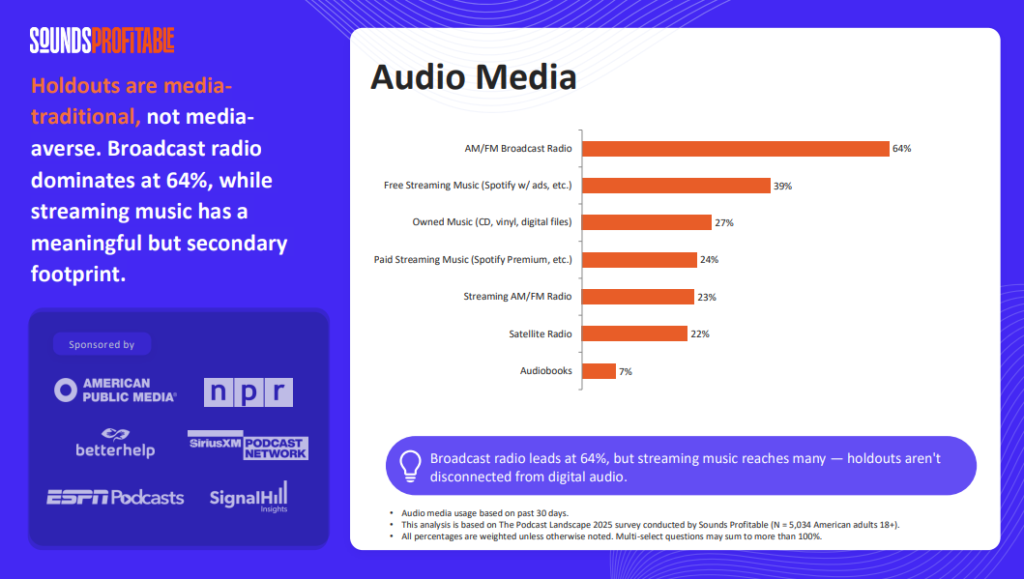
…then what do they listen to?
Radio is the big winner; 64% of the holdouts tune in. Streaming music (unpaid) is also popular in the group (at 39%); paid streaming music like Spotify is used by 24% of the podcast unlisteners. As seen below, the lesson is that podcast holdouts are not disconnected from digital audio; just from podcasting.
The survey measures year-over-year media trends, discovering that even in this group which is friendly to traditional media, there is migration toward digital video and TikTok, while loyalty to AM/FM radio shows a net decline of 16 point year-over-year.
Barriers to Podcasts
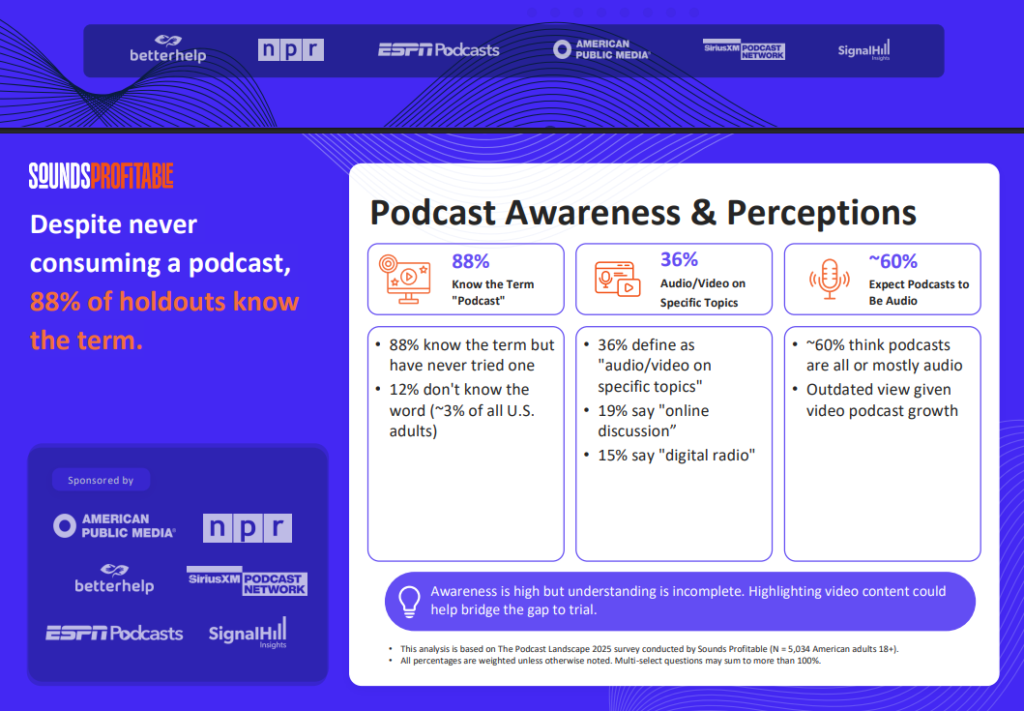
Getting back to the basic “Last Quarter” theme, the survey sought to learn whether podcasting is even a familiar term to unlisteners. It is:
As shown below, 88% know the term but haven’t listened, and descriptions of podcasting vary. Most respondents think podcasts are audio-only; Sounds Profitable calls this an “outdated view,” which is true but seems harsh to us as we remember that this population is unengaged in actually consuming podcasts.
The study identifies “barriers” to podcast consumption. We see them as alternate choices, but we get the point. In the list of 11 reasons why the unlistening group doesn’t consume podcasts, TV and movies co-occupy the top barrier. A kind of “no need” answer is #2: “Existing entertainment is sufficient” — inertia, basically. Reading is #3, and the fourth unlistening rationale is arguably the most interesting: “Don’t understand podcast benefits.”
Down the list, representing 11% of answers, is “Don’t like spoken audio.” That one’s hard to overcome.
From all this information (and more), the study conceives of “Barrier Clusters” — a kind of cheat sheet to understanding why some people don’t listen to podcasts. We present the bottom lines of each below, but there is much more explanation in the doc:
- Prefer TV/movies (41%)
- Don’t know how to consume (13%)
- Don’t like format (11%)
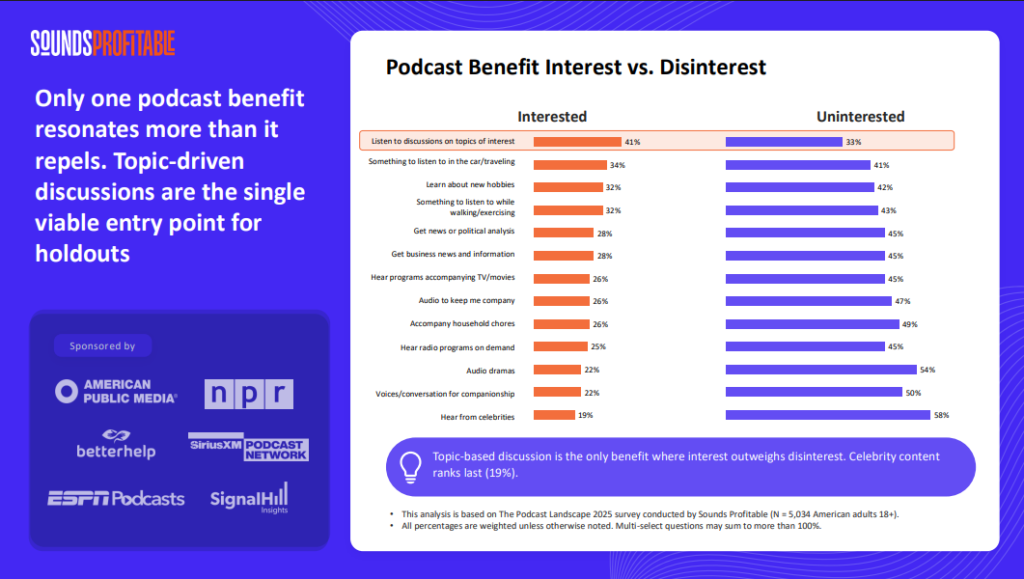
Pushing onward to better understand lack of interest in podcasts, the study compiles a list of potential benefits, correlated with binary survey reactions to those benefits, as interested or uninterested. We find this exceptionally, um, interesting. In the chart below we observe lack of fascination with celebrities, and the greatest interest in topical content.
Political profiling is standard in these demographic measurements, We see an approximately even party split, and political identities. When asked whether politicians should be podcast guests, exactly half the group didn’t care — “neither appropriate nor inappropriate.”
Key Insights
Tom Webster’s study closes with the traditional key insights. We will say, without intending to compromise objectivity, that they are gold for any organization stepping into podcasting, and existing podcast operations as well. The summary insights, and the entire study deck, are freely available HERE.