
In another study seeking to establish an understanding of AI’s role in music creation and consumption, London-based market research and advisory company MIDiA Research has published The State of AI and music. It’s a data report which seeks to understand who is using AI tools, what it means for music value. and where opportunities lie. The report is derived from a webinar presentation on April 28.
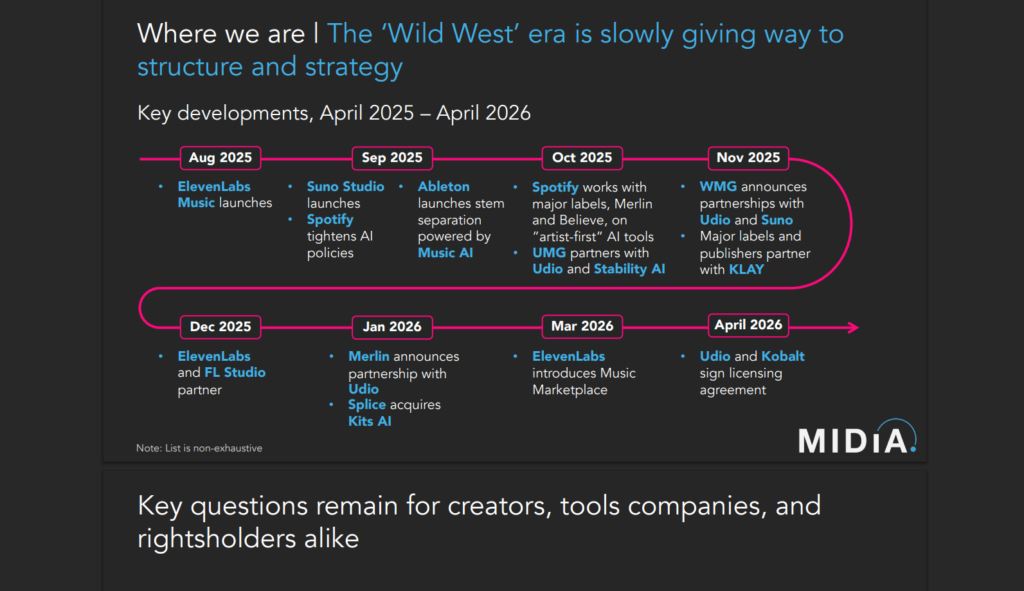
The “Wild West” provides a key allegorical theme. In that context, MiDIA Research asserts that the Wild West era of AI in music is giving way to a more structured and strategic business environment.
Along that line we are given a pictorial timeline of key industry policies, partnerships, and product launches, as seen below.
- A few key questions emerge amidst the rapid growth:
- Who is using generative AI music tools today, and how will that change over time?
- How will generative music platforms impact listening behavior and music value?
- What are the opportunities for artists and music industry players?
One apparent milestone is revealed in this research document:
Less than half (45%) said they used no AI tools
And how exactly is AI being used in the music production process? MIDiA’s research conducted in Q3 2025 answers this question graphically, as shows below.
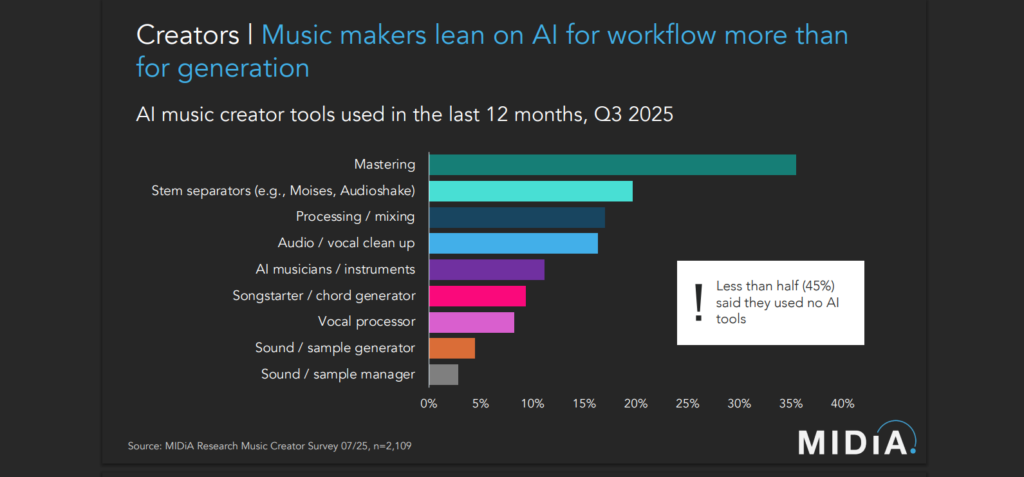
In that chart we observe that most AI use is deployed to technical aspects of production (mastering, processing, mixing, audio cleanup … as opposed to music creation tools which are used less.
From there, this study swings over to consumer use of AI for music generation, presumably for recrational listening. Here we see that AI is working both sides of the room — performance and audience. While that might be disappointing to music creators, this study observes something interesting:
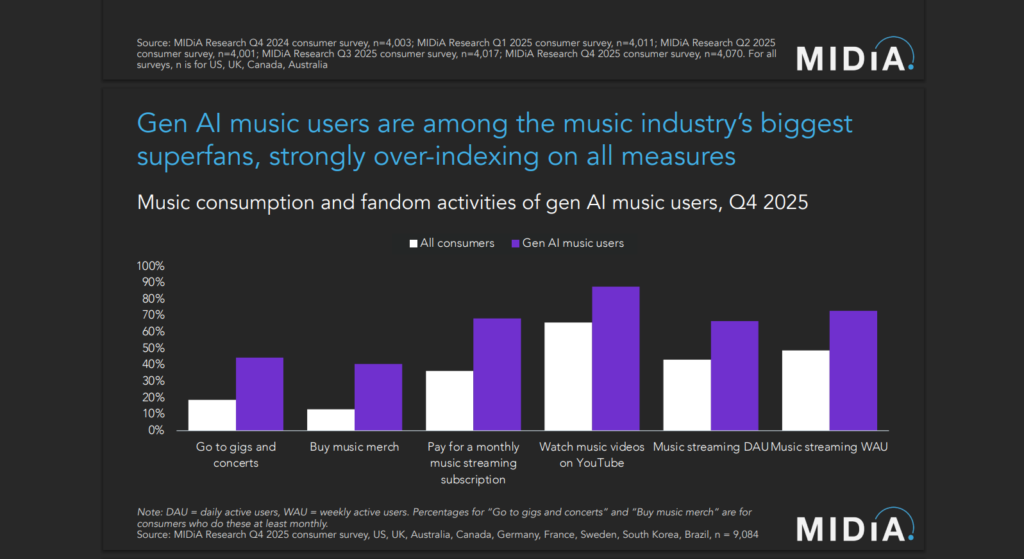
Here we see that Gen AI users are above-average human-music consumers in streaming, subscriptions, concerts, and merchandise.
A second section of this study — Listening and fandom — discovers that generative audio can most easily compete in spaces where listening is most passive.
This sophisticated and granular research is worth examining — the source deck is 18 solid data slides which explore topics we haven’t touched here. . As always we recommend the original, which is HERE.