


Edison Research (a subsidiary of SSRS) has released its annual study of podcast listener behavior and trends, titled The Podcast Consumer 2026.
Energetically presented online by Edison VP Megan Lazovick, the 51-page research deck documents several components of podcastings’ profile in he media industry:
- Reach (consumption growth
- Share (of consumer time spent with all audio sources)
- Content (lots of rankings)
- Audience Insights (listening habits; services, video, audience composition)
- Sports Poll (a section sponsored by SSRS, Edison’s parent company
- Trust and Loyalty (listener loyalty, AI in podcasting)
- Influence (receptivity to advertising, podcast value to brands)
Near-flawless growth
Edison presented a sweeping chart of podcast audience growth from 2008 through 2026. As depicted below, podcast listening has been above 50% of the 12+ U.S. population for two years, and is estimated to be 167 million listeners, or 58% of the teen/adult population.
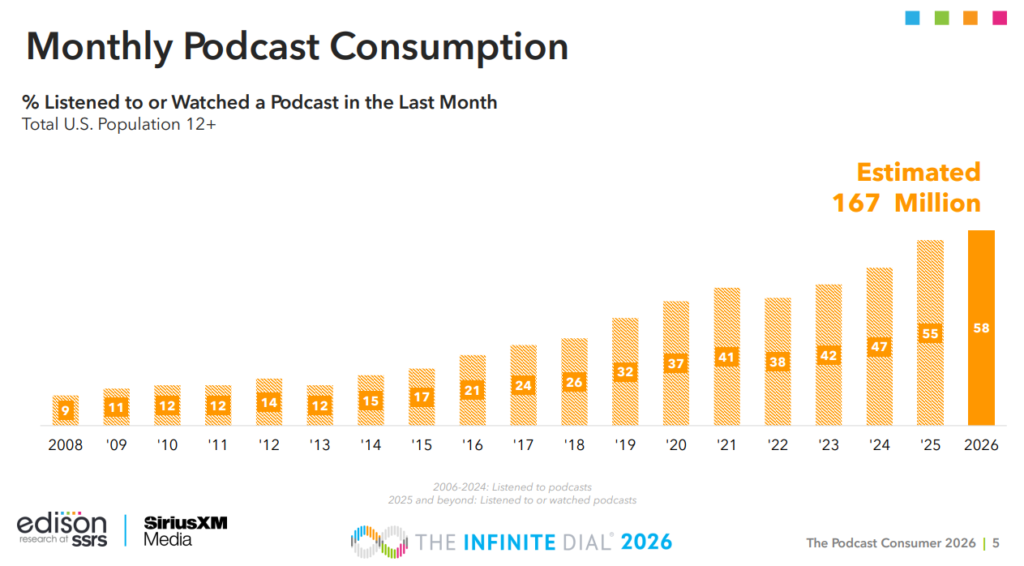

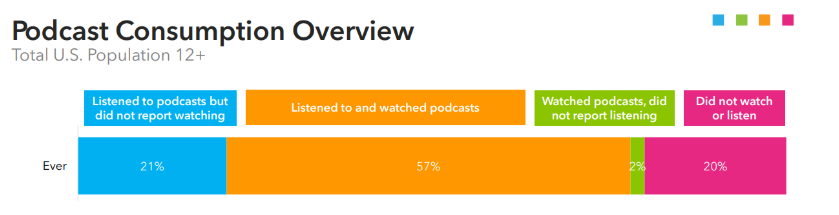
If the “monthly” requirement is removed from the graphic above, the statistic would be 80% of the U.S. adult population has ever listened to a podcast. That’s (an estimated) 210 million people.
The listened/watched divergence is nicely quantified by this infographic:

Several charts were presented digging into podcast consumption details, telling a story of broad generational attraction to podcasts. We learn that the following age groups a monthly podcast listeners::
+
64% of age 12-34
68% of age 35-54
44% of age 55+
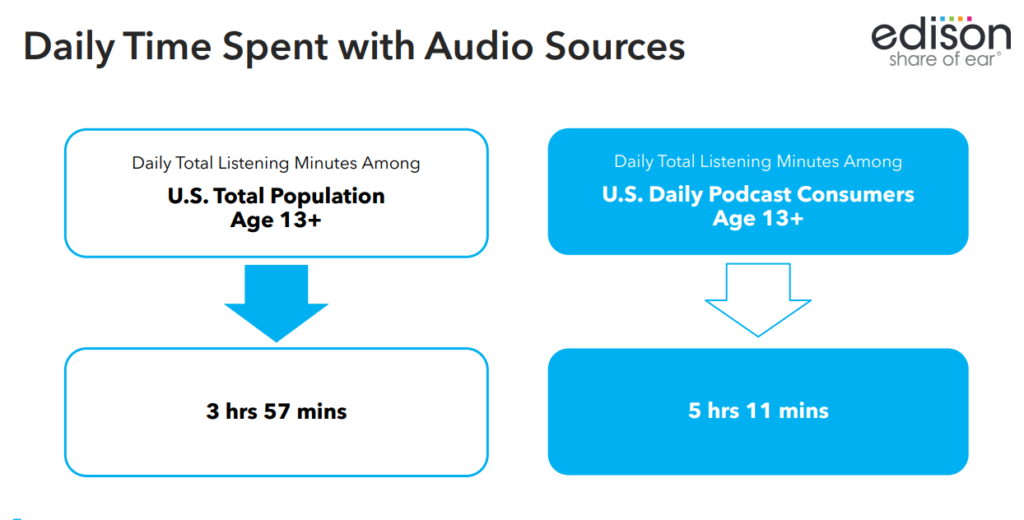
Broadening out from podcasting, we learn that the average daily listening time (all audio sources) among the entire U.S. population is three hours and 57 minutes — just shy of four hours a day. That’s the first part of Edison’s larger point. When narrowing the listening cohort from the entire population to daily podcast consumers, the average total listening time rises to 5 hours and 11 minutes.

Another section of audience insights put a focus on where listening happens (at home mainly) and the service used to stream or download the shows. YouTube receives the plurality of responses in this part of the survey, followed by Spotify and Apple Podcasts. It has been that way for three years of Infinite Dial.
When the above question is framed as a video/audio choice, Edison hit on a historic first in this study:
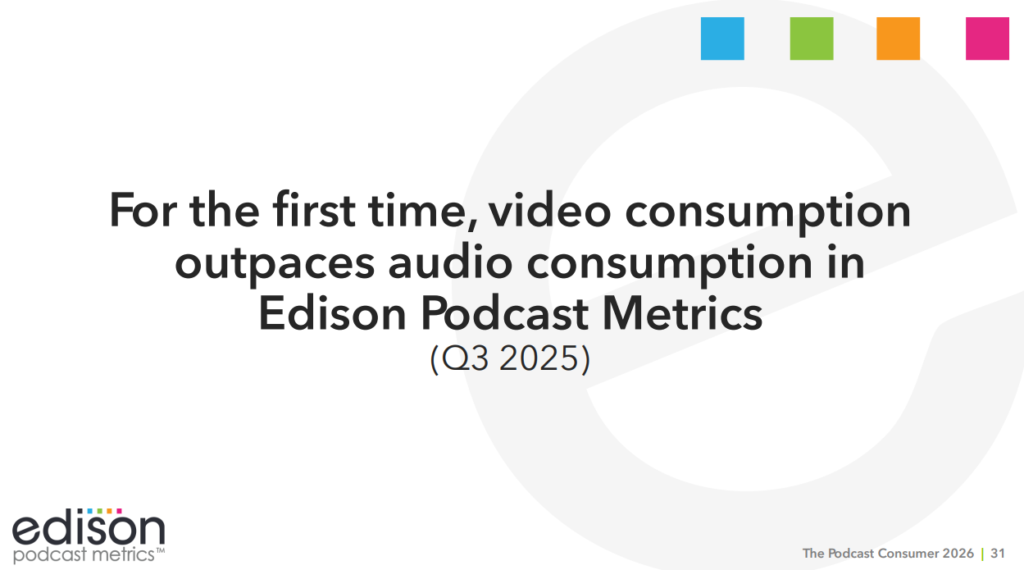

Edison devotes a couple of slides to detail the video/audio divide, then it’s on to audience composition metrics where you can learn detail of age and ethnic composition.
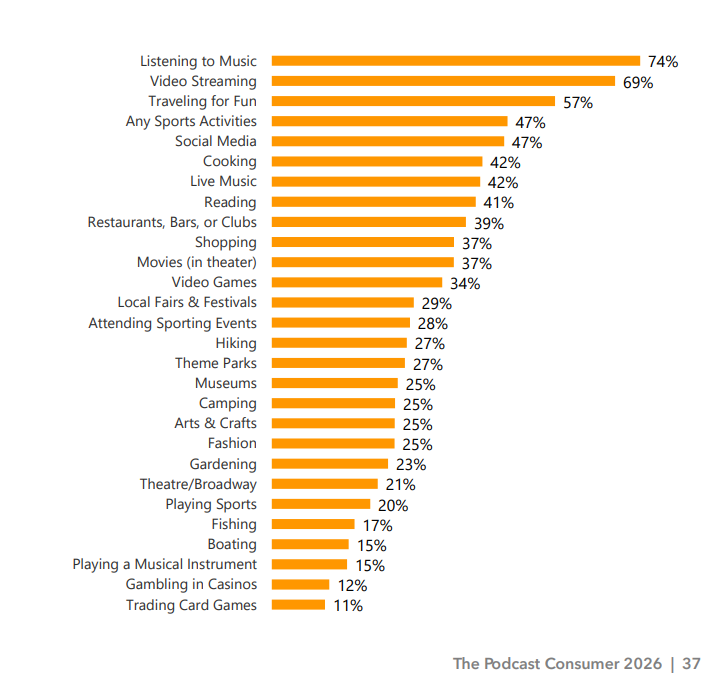
In this study of listener characteristics, Edison wondered what the most intense podcast fan did when they weren’t listening to podcasts. A lot of them were still listening (to music and video streaming). Survey respondents weren’t shy about their non-podcast hobbies:
In a section called Trust & Loyalty, survey participants were asked about AI. In a key Approve/Disapprove question, listener sentiment ranged widely depending on how the AI is used, as illustrated below.
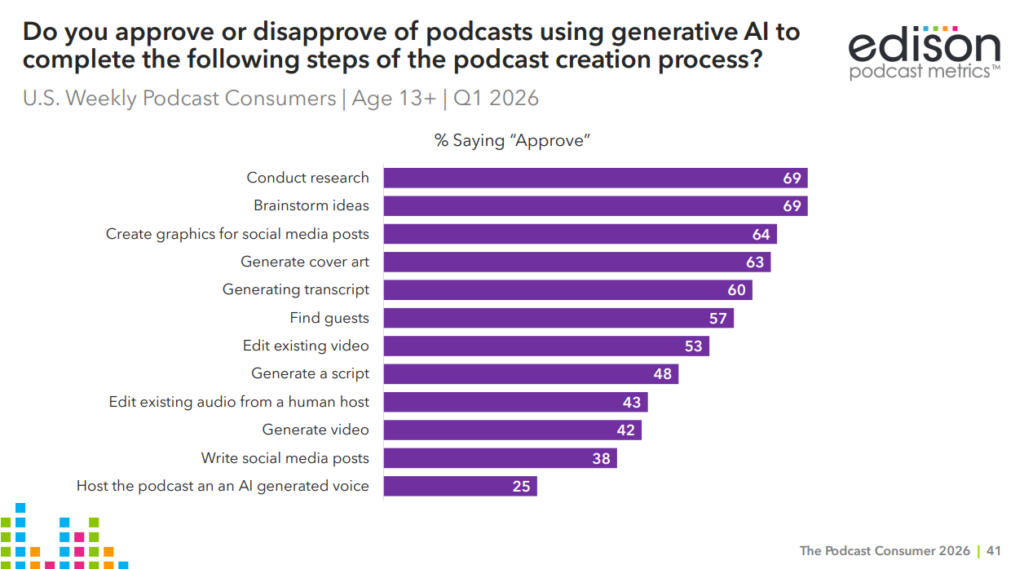
Fifty-nine percent of respondents thought AI was a threat to the credibility of podcasts.
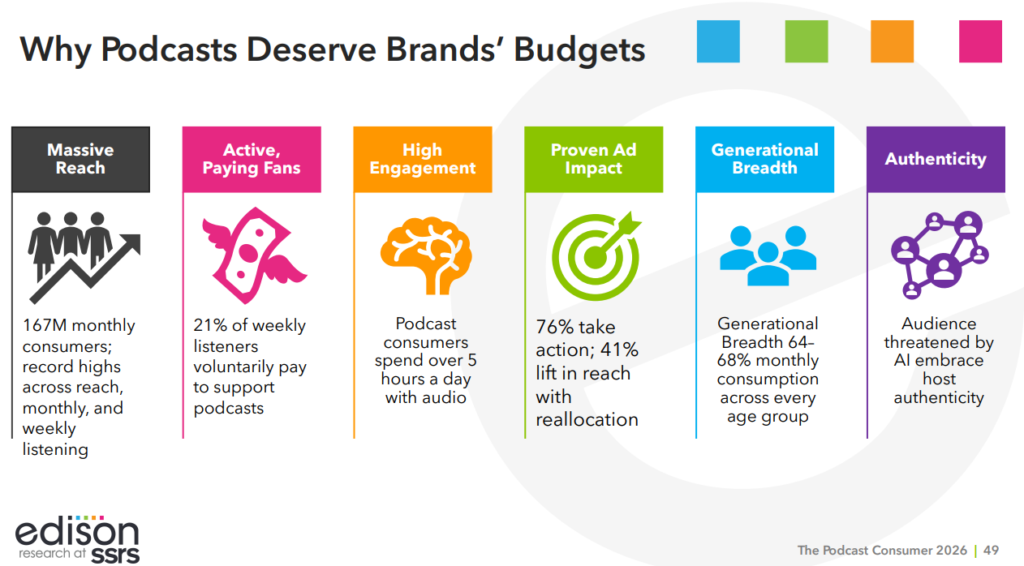
Of interest to advertisers is the receptivity and inclination to take action when hearing a podcast ad. Edison found good news there, with 76% of participants having “high ad receptivity.” Taking action is also a bright light, with the desirable 13-34 and 35-54 age groups showing a majority willingness to visit company and product websites. Recommending the advertised product is also fine for most in the younger groups … though not the age 55+’ers.
An interesting point: Making the listener laugh in a commercial increases the receptivity of almost all respondents.
The finale of this section is a six-point hammering of why the podcast category deserves a share of advertising budgets:
This review is a summary. As always we recommend the original presentation deck, which is located for download HERE.